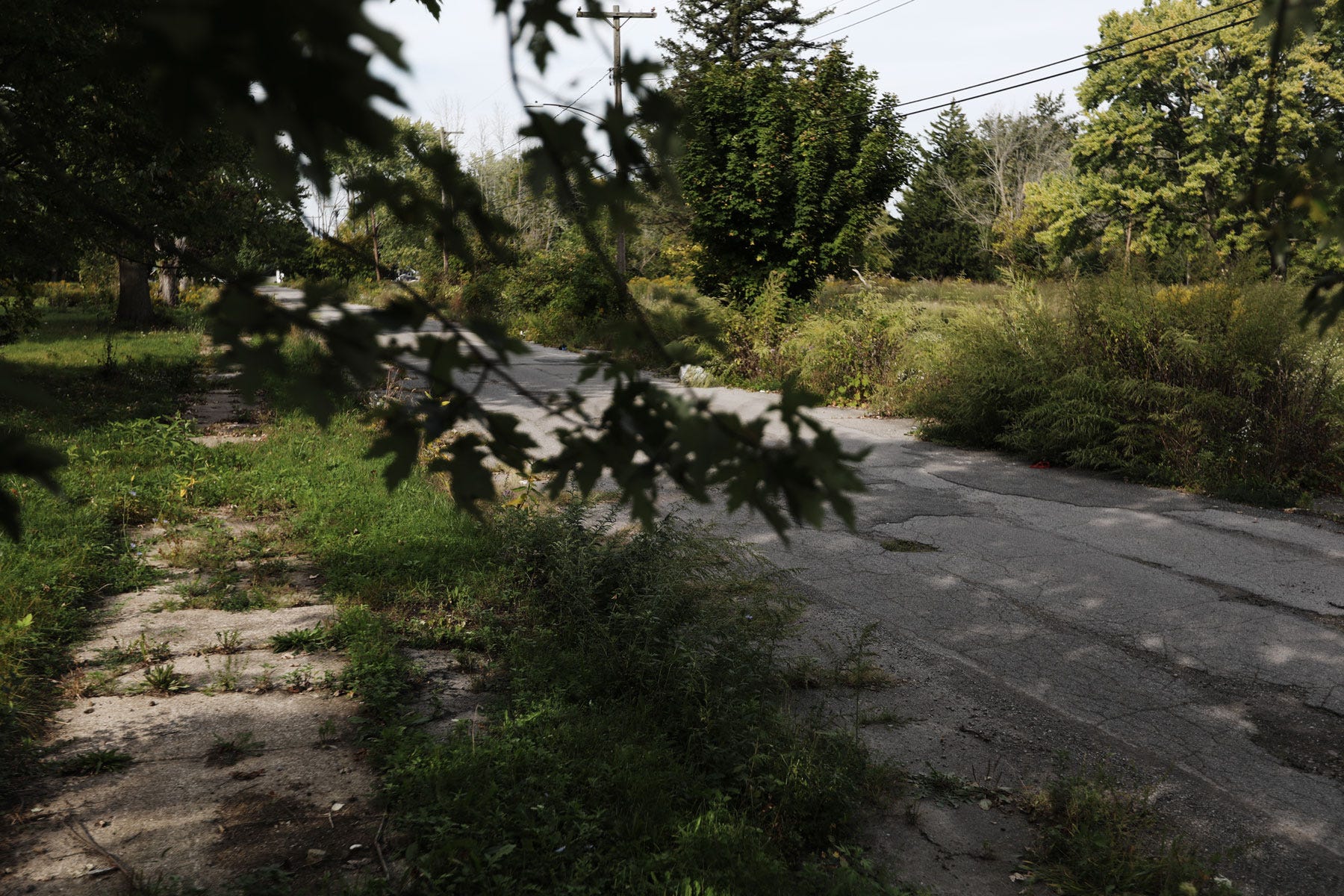
What remains of the Love Canal neighborhood, photographed Friday, Sept. 20, 2024
Photos in Niagra Falls, New York, by Eric Francis Coppolino
Love Canal: Another Look | By Eric Francis Coppolino
In late summer 2023, I made my first return to Love Canal in many years. In that condemned Western New York neighborhood, built on 23,000 tons of chemical and nuclear waste, is where my investigative reporting career began in 1983. My report was called Resettling Love Canal Amidst Unsettling Questions.
More than 1,000 homes and apartments and two schools were a “perfect suburb” until the waste barrels started popping up after the infamous Buffalo blizzard of 1977 melted. It took nearly three years to get most of the families out.
I was not happy with the my sunny-looking 2023 photos, which are in the first link below, along with much background information. I knew I needed to go back.
Love Canal is a difficult subject to photograph, being a study mostly in what is no longer there. You have a boring fence around a grassy field, some empty streets, house lots where homes no longer stand…a few occupied homes…a couple of abandoned homes…some trucks…and a creepy new playground built about 100 feet from the fence that separates the chemical dump from what remains of the neighborhood.
Glimpses of the Zone of Exclusion
Everywhere is the “this could be anywhere” feeling. That is crossed with glimpses of the Zone of Exclusion that surrounds the Chernobyl disaster that followed less seven years after the Love Canal evacuation. Still, there is not much to see, and what you can see exists mostly in the details. So you have to move slowly, and look.
My friend Charlie Lemay (1950-2025) helped me see the problems with my first set of photos, and I conceived a look for the next set. I knew I had to get closer in, and emphasize what remained rather than what had been added. More than anything, I wanted the photos to reflect how it felt to be there.
Charlie Lemay taught photography at St. Paul’s School in Concord, New Hampshire, and was an award-winning photographer and author. See more of his photos here.
Every House Lot Represents One Family
Going to Love Canal is a life-changing experience, a little like visiting the Catacombs of Paris. Seeing the slow decay of this once-(seemingly) perfect neighborhood is a reminder of what will eventually happen to all human civilization. They will crumble and melt into the ground.
At the same time, many thousands of occupied communities are built on toxic dumps, contaminated land or near point sources of toxins.
Seeing the still-standing and still-contaminated part of the neighborhood, north of Colvin Blvd., is a reminder of the lives that so many people gave up for their own health and safety. Every lot with a missing house represents one family whose life was irrevocably disrupted.
I feel a sense of ownership or perhaps stewardship of the place. While it is an environmental symbol, the Love Canal is all-but-totally forgotten. To make sure it’s remembered, I’ve adopted it as its only visiting artist. I’m planning another trip in the spring of 2026, this time bringing my new flying camera.
Acknowledgements
I remain indebted to Lois Gibbs, who led the evacuation, and who granted me many interviews over the years, and helped guide my work on the SUNY New Paltz dioxin dorms situation in 1992 and for some time after.
I am also grateful to Luella Kenney for her wisdom and personal story, which you can hear in the first link below. Dr. Steven Lester, science advisor to the Love Canal residents, has also helped me many times in the course of my investigative reporting.
To this day, it astonishes me that the Niagara Falls School Board, who caused the whole problem, was never held accountable. The Love Canal neighborhood was their creation; the chemical polluter warned them this was no place for a school.
Resources
A Sort of Homecoming: Return to Love Canal (photos and 2023 Luella Kenney interview by Eric Francis; and many other resources.)
Resettling Love Canal Amidst Unsettling Questions by Eric Francis, 1983
Poisoned Ground (documentary). That is excellent for the visual side of the situation, with much amazing, nearly-lost archival video footage, accurate reporting and an honest sense of the zeitgeist.
The relatively new book Paradise Falls by Keith O’Brien is the best document if you want to go behind the scenes and understand who helped make the evacuation happen.
See map.


Love your work
I think what you captured best in these photos is how the Earth reclaims land and heals Herself, despite the nasty stuff that remains in the soil and water-- like a curtain is being drawn or a door is being closed (or opening?). A gradual shift in realities. The photo of the street being disappeared by tall grass and weeds was especially moving; overall it feels to me like you've documented a healing process.