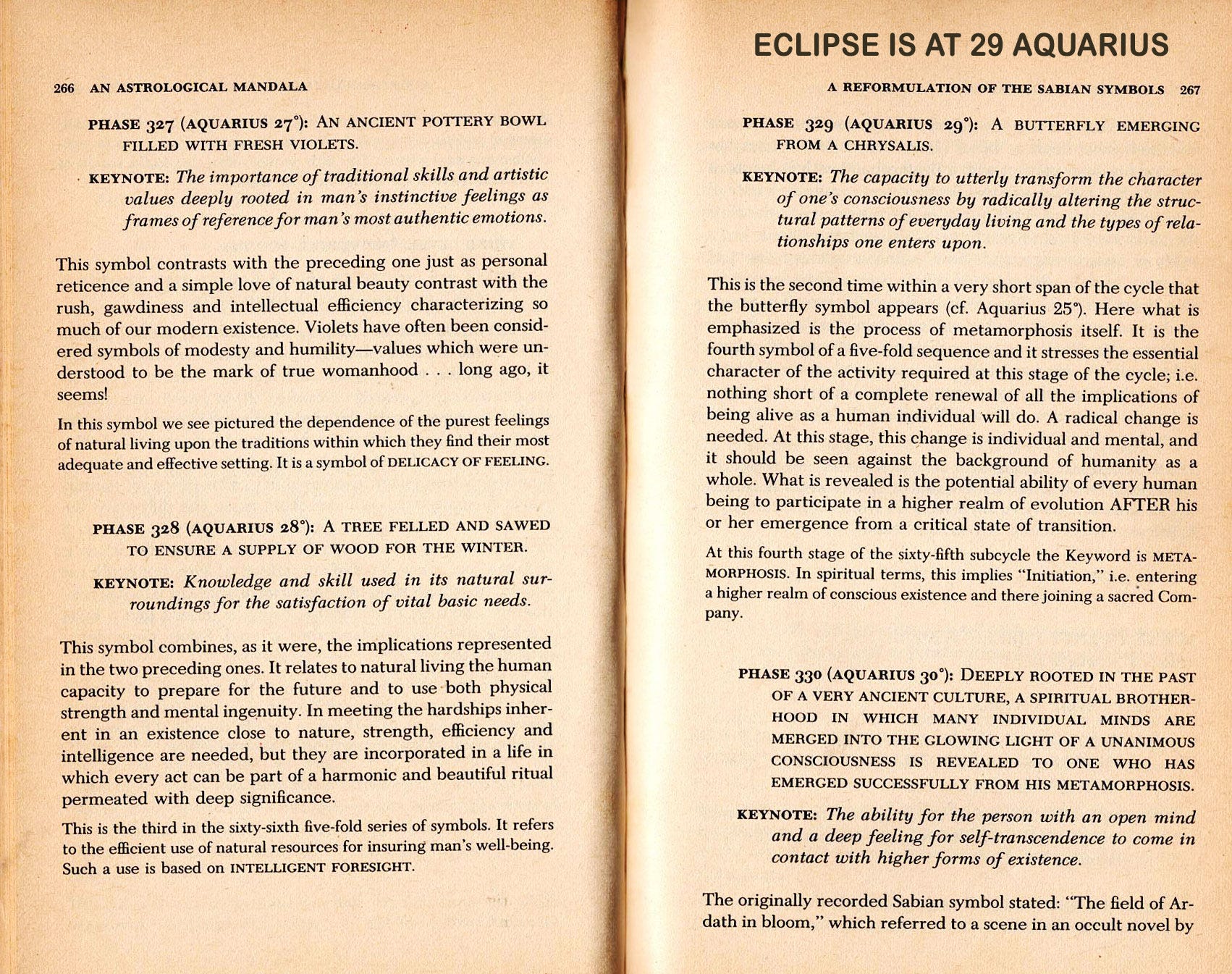


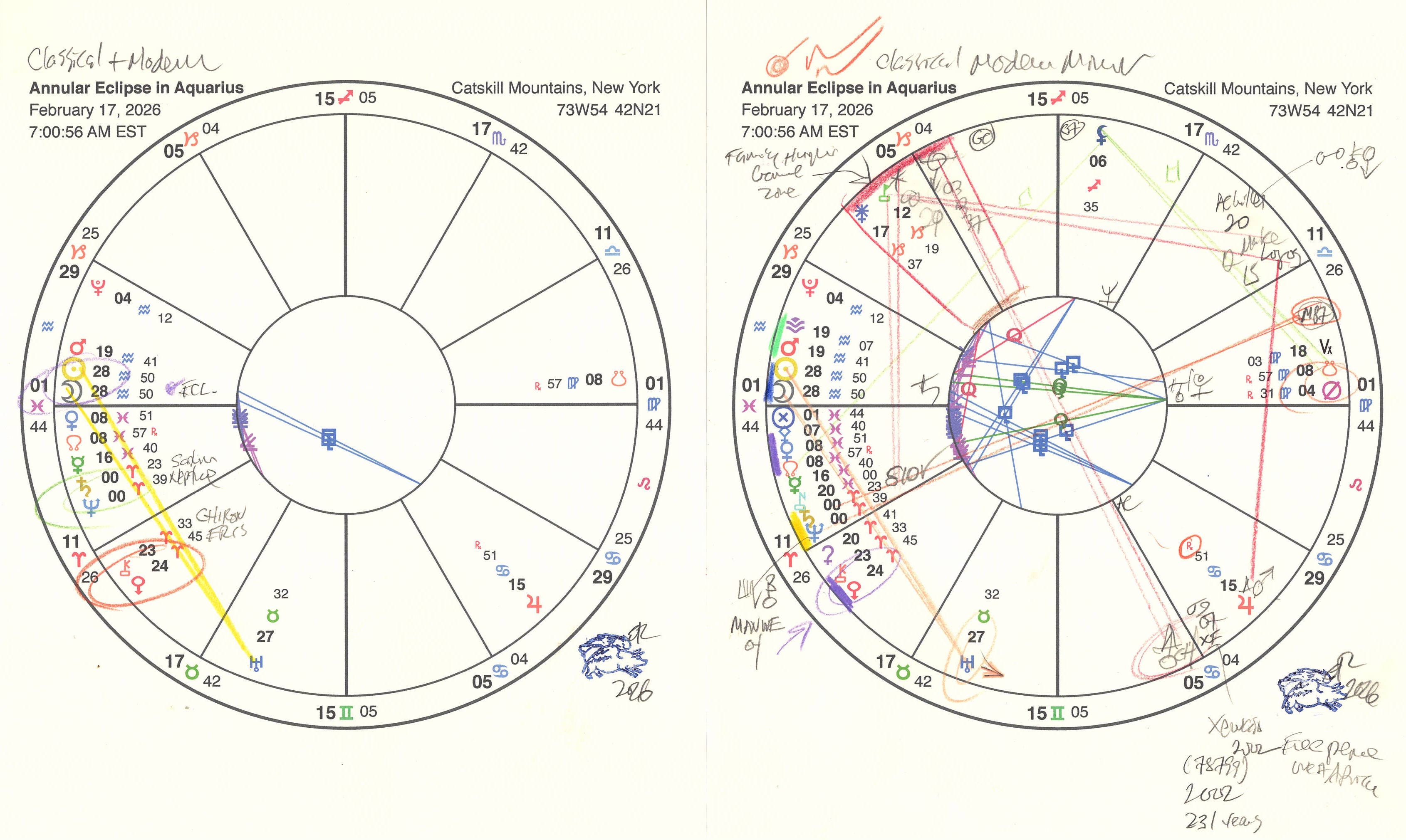
Simplified and full charts for Tuesday’s annular eclipse of the Sun
Oh, by the way, it’s eclipse time
This week, we have an annular (New Moon) solar eclipse in late Aquarius followed on March 3 by a total lunar (Full Moon) eclipse in Virgo. This comes amidst much fanfare associated with events in Aries.
What does it all mean? Look at the world. I know it’s always seemed this nuts, but your old Uncle Eric is here to tell you that right now we’re getting a special serving of everything all at once. Consider your life and all the ways you’re growing. If you’re wondering what all this astrology is about for you, check out my Inner Light readings.
If you want a quick and easy discussion of how eclipses work and what I think their ‘effects’ are, try my somewhat recent article The Venturi Effect where I attempted to sum it all up in one place with a cool graphic of a Venturi. If you appreciate this kind of human-scale but fully brain-engaged astrology, you’re invited to subscribe to Planet Waves. We have the best archives in the business.
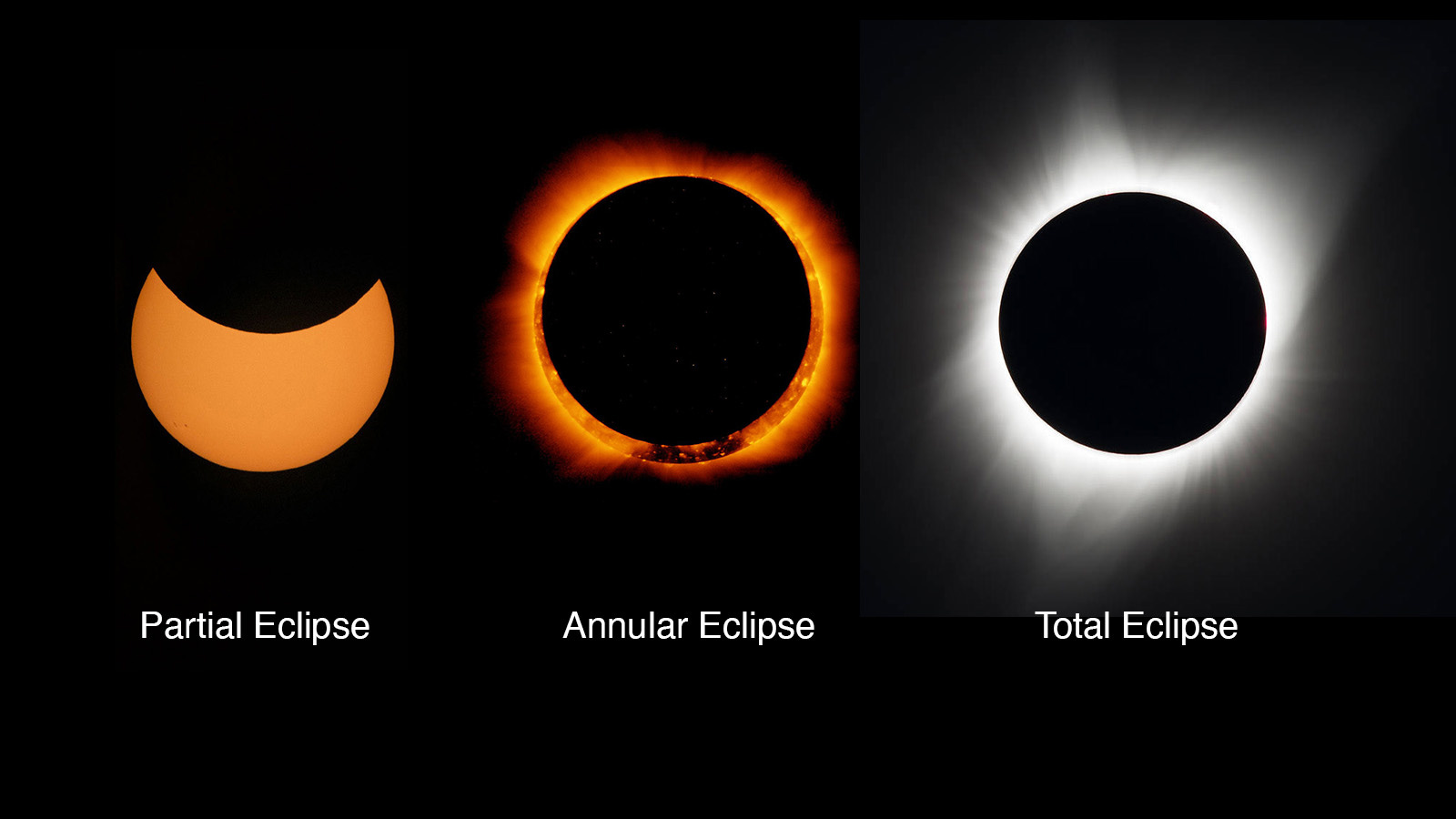
Annular, not Annual
An annular (not annual) eclipse would be a total eclipse but the Moon is sufficiently far from Earth (at or near apogee) that it does not cover the disk of the Sun. This occurs with the New Moon at 28+ Aquarius (degree 29), and is circled in purple just above the horizon to the left. Then you can see Saturn and Neptune, both with the zeros next to them, circled lightly in green.
Gradually, over the aeons, the Moon is spinning further from the Earth, and in the future all total eclipses will become annular eclipses. So it’s a special feature of our epoch that total eclipses are even possible.
In the figure to the left, I’ve removed the demolition debris and driveway shale, otherwise known as asteroids and chunks of rock and ice out by Pluto; and I’ve included what should now be considered modern planets Chiron and Eris (circled in red). The term “modern planet” generally pertains to Uranus, Neptune and Pluto.
In the chart to the right, I’ve added a diversity of “minor” (meaning not-so-minor, as in minor key in music rather than Minor League™ in baseball) planets, several hypotheticals, and three deep-space points (two located in mid-late Sagittarius and one in early Libra).

That’s Okay, You Can Skip the Minor Planets…Or Not
I understand if anyone doesn’t believe in those things; leaving them out makes the chart seem simpler and avoids confusion at the GED or Community College level. We, however, attend the University of the Universe and go bowling and hang out in the student newspaper office in the Astrology Student Union.
Of note, the Saturn-Neptune conjunction, exact Friday in/on/at the Aries Point, occurs in a close opposition to the massive galaxy M87. OK whatevs yeah big deal. But M87 is not your average galaxy, being relatively nearby (in the Virgo group), controlling the movement of every galaxy anywhere in proximity to the Milky Way, and also containing more than one trillion stars. So this is and will be greatly amplifying the voice and the influence of Saturn-Neptune. Just the black hole at the core of M87 is the equivalent of 6.5 billion solar masses.
M87 is in my view what makes Libra the sign of the human blowtorch and which also at least partly accounts for my patented highly exclusive Libra Rock Star Theory of Astrology. (Part of that effect also comes from Venus; you can tell because there are a heck of a good few exemplary Taurus rock stars, too, a list that begins and ends with Brian Eno.)

It is worth pondering whether M87, a fixed point now located in very early Libra, is what brings the energy to what what we think of as the Aries Point. A trillion stars packed around 6.5 billion solar masses? Jesus Murphy!
Anything (as in a planetary event) that happens early in any cardinal sign or in the middle of any fixed sign directly aspects M87, and hence, the Aries Point. Its position was very close to 00+ (first degree) Libra starting one century ago (coincidentally, when Eris entered Aries at the dawn of the mass communication era!).
However, the Aries Point (or Sidereal Vernal Point) is an oldie, originally used by Claudius Ptolemy as early as the 2nd century CE, way back when it was located in tropical Virgo.
However, that does not obviate the possibility that M87 (first catalogued March 18, 1781, within a mere five days of the discovery of Uranus!!) is greatly amplifying the effect as it has gradually precessed and came into alignment with the tropics. I promise that will eventually make perfect sense.
All that history aside, the first-ever Saturn-Neptune conjunction on the Aries Point (at least since 4500 BCE) stands in opposition to M87. And it’s happening now, accentuated by much else with the added greased lightning of Tuesday’s annular eclipse in Aquarius. This one is big…stop children, what’s that sound.
Faithfully,